What separates organizations that consistently attract top talent from those that struggle to keep it? The answer, more often than not, comes down to how intentionally they manage the employee journey from end to end. Employee lifecycle management is the strategic framework that connects every phase of that journey — from a candidate’s first impression of your brand to the day they transition out of the company — into a unified, measurable system designed to improve retention, boost performance, and fuel long-term growth.
In 2026, the stakes have never been higher. Talent shortages, hybrid work complexities, and rising employee expectations mean that reactive HR practices are no longer enough. Organizations that take a proactive, data-driven approach to employee lifecycle management consistently outperform competitors in retention rates, productivity benchmarks, and employer brand strength.
This guide breaks down the 7 key stages of the employee lifecycle, shares actionable strategies for each phase, and shows you how the right tools can transform disconnected HR processes into a cohesive, high-performance people operation.
What Is Employee Lifecycle Management?
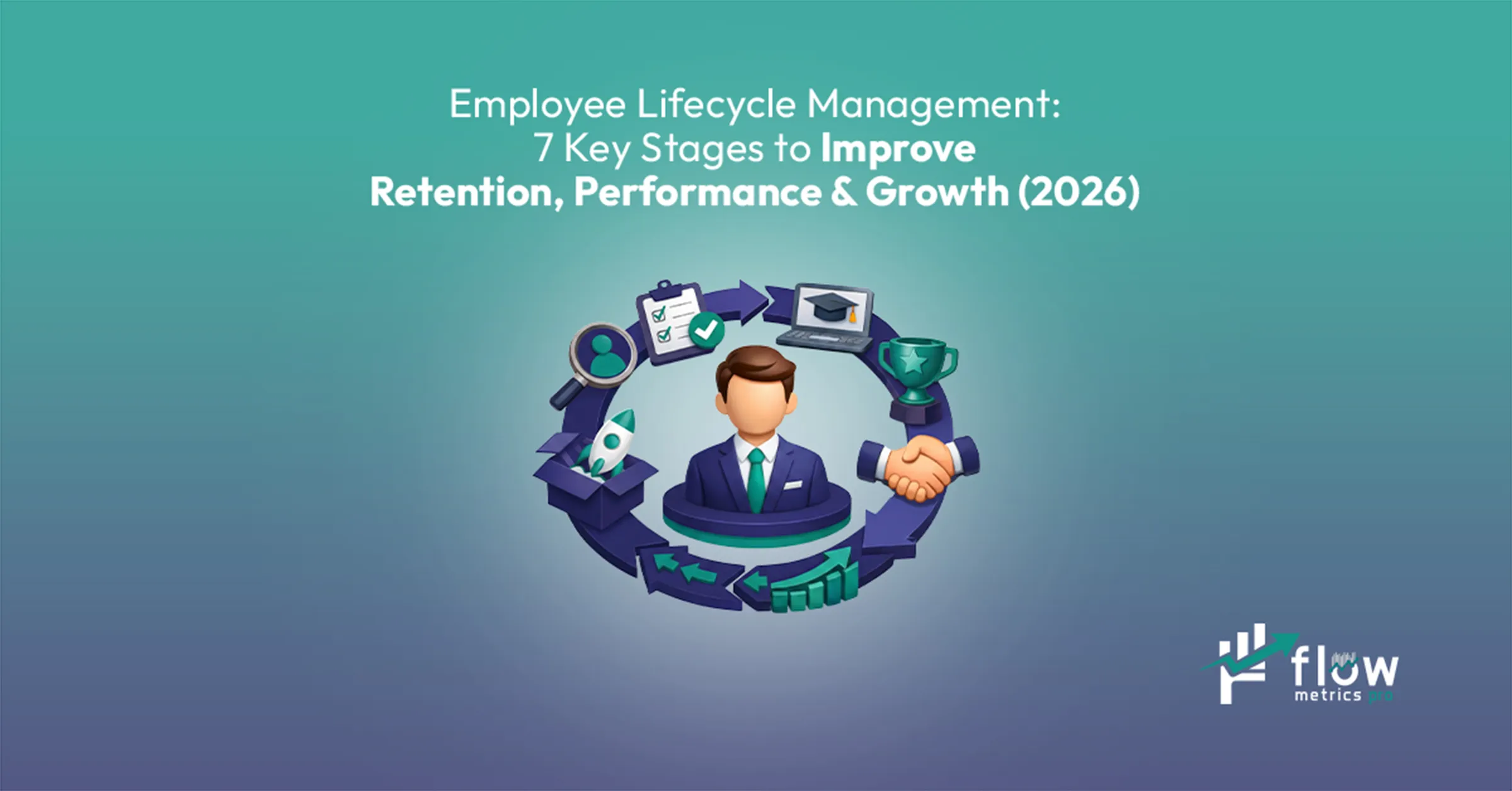
Employee lifecycle management refers to the end-to-end approach an organization takes to oversee, optimize, and measure every stage of an employee’s experience within the company. Rather than treating recruitment, onboarding, development, and offboarding as separate functions, employee lifecycle management views them as a connected continuum — where each phase directly shapes the next.
Think of it as a circular journey rather than a straight line. A well-offboarded employee becomes a brand ambassador who refers future talent. A highly developed employee becomes a retention success story. An exceptional onboarding experience sets the foundation for long-term performance. When all these stages are designed with intention and measured consistently, the compounding effect on business results is significant.
Research from Gallup consistently shows that organizations with highly engaged workforces outperform peers by up to 147% in earnings per share. Engagement, at its core, is the product of effective employee lifecycle management — built stage by stage, touchpoint by touchpoint.
Platforms like FlowMetrics Pro are purpose-built to help HR teams manage the full employee lifecycle from a single, unified platform — connecting data across hiring, onboarding, performance, and offboarding to deliver actionable insights at every stage.
Why Employee Lifecycle Management Matters in 2026
The modern workforce has fundamentally changed. Employees have more choices, more information, and higher expectations than ever before. The average cost of replacing an employee now ranges from 50% to 200% of their annual salary, depending on role complexity and seniority. For a company of 500 people with even a 15% annual turnover rate, that translates to millions of dollars lost annually in recruitment, training, and lost productivity.
Beyond cost, there is the performance dimension. Employees who feel supported, developed, and valued at each lifecycle stage consistently deliver higher output, greater innovation, and stronger customer outcomes. Employee lifecycle management is therefore not just an HR discipline — it is a core business strategy directly linked to revenue, culture, and competitive advantage.
The 7 Key Stages of Employee Lifecycle Management
A robust employee lifecycle management framework organizes the employee journey into seven distinct, actionable stages. Each stage presents unique opportunities to strengthen retention, elevate performance, and drive growth.
Stage 1: Attraction — Building a Brand That Draws Top Talent
Attraction is where employee lifecycle management begins — long before a resume lands in your inbox. Your employer brand, company culture, job descriptions, social media presence, and employee reviews on platforms like Glassdoor and LinkedIn collectively shape whether high-quality candidates want to work for you. In 2026, candidates research employers as thoroughly as companies research candidates.
Key strategies to improve attraction:
- Define and communicate a compelling Employer Value Proposition (EVP) that speaks to what makes your organization different.
- Leverage authentic employee testimonials and behind-the-scenes content on LinkedIn, Instagram, and Glassdoor.
- Optimize job descriptions for both search engines and candidate experience — clear, inclusive language converts more applicants.
- Track employer brand sentiment regularly through candidate surveys and review platform monitoring.
Stage 2: Recruitment — Converting Interest Into Quality Hires
Recruitment is the operational engine of employee lifecycle management. A slow, inconsistent, or biased hiring process does more than lose candidates — it actively damages your employer brand and costs the business money. In 2026, top candidates are off the market within 10 days on average. Speed, structure, and a candidate-first experience are non-negotiable.
Key strategies to improve recruitment:
- Implement structured interviews with standardized scorecards to reduce bias and improve decision quality.
- Set and communicate clear timelines to candidates — radio silence kills conversion rates.
- Use an Applicant Tracking System (ATS) integrated with your HRIS to eliminate data silos between recruiting and HR.
- Measure quality of hire at 90 days and 12 months to continuously improve your sourcing and selection approach.
Stage 3: Onboarding — Setting the Foundation for Long-Term Success
Onboarding is one of the highest-leverage stages in employee lifecycle management. Get it right, and you dramatically increase the probability that a new hire becomes a high performer who stays. Get it wrong, and you risk losing them within the first 90 days — taking all your recruitment investment with them. Research from the Brandon Hall Group shows that strong onboarding improves new hire retention by 82% and productivity by over 70%.
Key strategies to improve onboarding:
- Start onboarding before day one — send welcome packages, system access, and introductions in advance.
- Design a structured 30-60-90 day plan with clear milestones, manager check-ins, and early win opportunities.
- Assign onboarding buddies to accelerate social integration and cultural understanding.
- Collect structured feedback at 30, 60, and 90 days to continuously improve the onboarding experience.
Stage 4: Development — Investing in Performance and Growth
Development is the stage where employee lifecycle management has the most direct impact on performance and long-term retention. Employees who see a clear path forward — through skills training, mentorship, stretch assignments, and career conversations — are significantly less likely to look elsewhere. According to LinkedIn’s 2024 Workplace Learning Report, 94% of employees say they would stay at a company longer if it actively invested in their development.
Key strategies to improve development:
- Build individual development plans (IDPs) collaboratively between employees and managers, reviewed quarterly.
- Create internal mobility pathways — lateral moves and stretch roles are as powerful as promotions for retaining talent.
- Invest in manager capability: managers who coach, not just direct, generate dramatically higher team engagement scores.
- Blend formal training with on-the-job learning, peer mentorship, and access to external conferences or certifications.
Stage 5: Retention — Keeping Your Best People Engaged
Retention is where all your employee lifecycle management investments either pay off or fall short. It is not a single initiative — it is the cumulative result of how well you have hired, onboarded, developed, recognized, and supported your people over time. The most effective retention strategies in 2026 are predictive rather than reactive: identifying flight risks before they become resignations.
Key strategies to improve retention:
- Run quarterly pulse surveys and act visibly on the results — employees disengage when feedback disappears into a void.
- Train managers to conduct stay interviews — proactive conversations about what is keeping employees engaged and what might push them away.
- Benchmark compensation regularly and close gaps before they become reasons to leave.
- Recognize contributions consistently — both formally through reward programs and informally through manager recognition.
Stage 6: Offboarding — Exiting with Dignity and Insight
Offboarding is the most underestimated stage in employee lifecycle management. How an organization handles departures sends a powerful signal to everyone still on the payroll. A respectful, structured offboarding process — including thorough knowledge transfer, meaningful exit interviews, timely final payments, and same-day access revocation — turns departing employees into lifelong brand ambassadors. The Society for Human Resource Management (SHRM) provides detailed frameworks for building legally compliant, compassionate offboarding workflows that protect both the organization and the departing employee.
Key strategies to improve offboarding:
- Conduct structured exit interviews (or anonymous surveys) and analyze themes across departures to identify systemic issues.
- Create knowledge transfer templates to capture institutional knowledge before it walks out the door.
- Automate system access revocation on the last working day to eliminate security gaps.
- Send a genuine farewell communication from leadership that acknowledges the employee’s contributions.
Stage 7: Alumni Engagement — Turning Former Employees Into Lifelong Advocates
The most forward-thinking organizations treat alumni engagement as an active, strategic component of employee lifecycle management rather than an afterthought. Former employees who leave on good terms can become your best recruiters, your warmest referral sources, and even boomerang employees who return with new skills and broader perspectives. Alumni networks, quarterly newsletters, LinkedIn communities, and exclusive events keep your brand top of mind long after the employment relationship ends.
Key strategies to improve alumni engagement:
- Create a formal alumni LinkedIn group and designate someone to keep it active with relevant content and updates.
- Send a quarterly alumni newsletter with company news, open roles, and industry insights.
- Build a clear boomerang hire policy so returning employees know they are welcome and how to re-engage.
- Track referrals from alumni to measure the ROI of your alumni engagement program.
Best Practices for Employee Lifecycle Management in 2026
Beyond optimizing individual stages, the most successful organizations apply these cross-cutting best practices to their overall employee lifecycle management strategy:
- Unify your data: Break down silos between your ATS, HRIS, payroll, and performance systems. A single source of truth enables better decisions at every lifecycle stage.
- Automate administrative work: Free HR teams to focus on strategic, human-centered tasks by automating offer letters, onboarding checklists, benefits enrollment reminders, and offboarding workflows.
- Measure at every milestone: Deploy lifecycle surveys at 30 days, after annual reviews, and at exit. Use the data iteratively — not just to report, but to close gaps.
- Make managers accountable: Managers are the single biggest driver of employee experience. Build manager effectiveness metrics into your HR scorecards.
- Personalize the experience: Use data and segmentation to tailor communications, development plans, and recognition to individual career stages, roles, and preferences.
How Technology Powers Modern Employee Lifecycle Management
The difference between average and excellent employee lifecycle management often comes down to technology. Modern HR platforms use artificial intelligence to surface disengagement signals early, predictive analytics to identify high-potential employees, and automated workflows to ensure that no lifecycle touchpoint is missed or delayed. Research published by Deloitte Insights shows that organizations using integrated HR technology consistently report higher employee satisfaction scores and measurably lower voluntary turnover than those relying on disconnected point solutions.
When evaluating an employee lifecycle management platform, look for: end-to-end integration across recruiting, onboarding, learning, and performance; real-time workforce analytics dashboards; configurable automation for routine HR tasks; mobile accessibility for distributed and hybrid teams; and robust compliance and reporting capabilities.
Common Employee Lifecycle Management Mistakes to Avoid
Even well-resourced HR teams make recurring mistakes that undermine their employee lifecycle management results. The most common pitfalls include: over-investing in new hire experiences while neglecting mid-tenure employees; collecting exit interview data but never acting on it; treating onboarding as a single-day event rather than a multi-month process; failing to measure manager effectiveness; and using disparate systems that make it impossible to see the employee journey holistically. Addressing these gaps systematically — rather than reactively — is what separates good HR from great people operations.
Conclusion: Build a Lifecycle That Retains, Performs, and Grows
Employee lifecycle management is not a project with a finish line — it is an ongoing, compounding investment in your most valuable asset: your people. Each of the 7 key stages explored in this guide represents a concrete opportunity to improve retention, elevate performance, and drive organizational growth. When managed with intention, data, and the right technology, these stages reinforce one another to create a virtuous cycle of talent attraction, engagement, and advocacy.
In 2026, the organizations that win the talent game will be those that treat every employee touchpoint as strategic — not transactional. Whether you are formalizing your HR processes for the first time or evolving a mature people strategy, the 7-stage framework in this guide provides the roadmap you need to build a workforce that stays, grows, and delivers.
Ready to transform your approach to employee lifecycle management? Discover how a unified HR platform can help your team reduce turnover, accelerate performance, and build a workplace where your best people choose to stay and grow.